How do we do it? On the road for exactly 4 years and 8 months and 2 days…Life is too short to waste a moment. If you need to ask, well I’m so sorry for you. This last week/month has been a tremendous insight into so many things. Who really needs to discuss the elephant in the room?
With so many friends of ours that have moved from the US to live in other countries, it’s good to hear the insight from “boots on the ground”. Of course we’ve made a list of things we’d like to have, and those that are a must, where ever it is we decide to call home base.
Can anyone ever really live the “perfect life”?
We asked some and they will say that a “community” is important. We agree. We will say that temperature and climate as a whole impacts our decision greatly. Others claim the silence, cost of living, food, water, power…being off grid. Things, it seems we are conditioned to as “privileged” Americans. I think friends, location to things we like to do, access to water sports, and a small carbon footprint if possible, also are high on the list. Clean air and good health care are not something that can be denied.
How do we proceed? Good question. Perhaps the real answer is that we will never be comfortable in any one place for too long. Perhaps a few months here and a few there. No real commitment and there in perhaps lies the real issue. Why commit? After all, we are wanderers, travelers.
There are a few reasons to find a home base…one a place to feel grounded, your own. We have our place in TRNC, ready in Feb of 2027…but until then? Why do we feel a need to find one place? A place we “own”? A need to spend money? Some will say, if you’re comfortable in your own skin, there’s no need to find comfort from outside. Yes and no. It’s not that comfort we are looking for.
The future is so uncertain. We will most likely agree to rent, long term, and leave when the urge comes. We are not getting any younger and eventually will need a “home”. Somewhere they don’t throw away their old people. A place to travel from.
A place that targets health and well-being over treating dis-ease. A kind and stable government.
We are wrapping up a week in Tulum, where we ventured out to see if we could find a place to call home base. Once again, the homes were lovely, one we both were ready to buy. The next day we went out again to look and we stood in the jungle for about half an hour and we both began to feel ill from over heating. We took it as a sign that this is not someplace we could enjoy for long. Oh well…on to Oaxaca for 2 weeks of fun!!
Today and yesterday were memorial days for Chris and I. Loosing two family members a day apart is tough. That was only 3 years ago. Life is too short and too unpredictable to let one moment pass by without taking every advantage it may hold…a lesson, a creative thought, a feeling, a beginning or an end.
The older we get, the more we run away from the inevitable end coming at us like a freight train in a long tunnel. What is important today may not be tomorrow. It is so hard to really think about death, when we are living so hard but each step we take now, will have a ripple effect throughout our lives.
Letting go of all our possessions 5 years ago was a release I really can’t put to words. It is so freeing. There is a struggle with “things”, and it is those things that will kill us or cause suffering we can’t understand, nor are willing to realize. That shiny apple will eventually shrivel and die and our suffering increases ten fold.
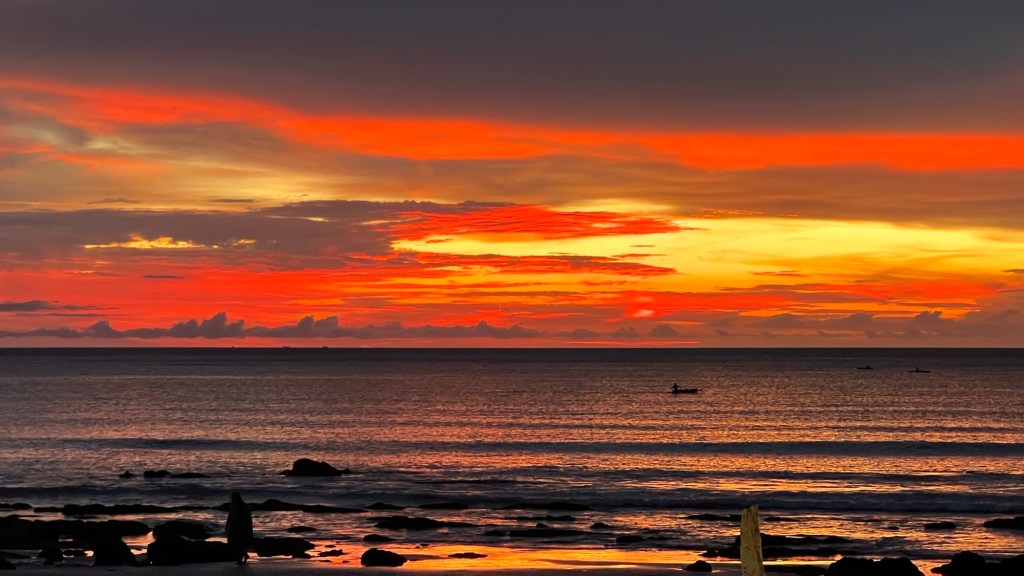
What brings me pleasure is the simple things that can’t be owned or put into a box. The sunrise and sunset, warm breezes on a cold day, sand between my toes, the sound of birds, the wind, the waves, the warmth of the sun, music, good food, good friends, petting an animal, trees, grass and the desert. All these things are different each time encountered because of change/impermanence, but I still feel that familiar comfort and ease at each chance encounter. We’ve learned to relish every moment, good or bad, knowing that if something is off, there will always be a change, be it in a moment, a day or a week, and the good is for that moment only and to be cherished. I’m rambling.
Bottom line…life is too short to sweat the small or big stuff. Life can be less about suffering and more about the joy of letting go and letting be. Get out and smell the air, feel the sun, listen to nature and LIVE!
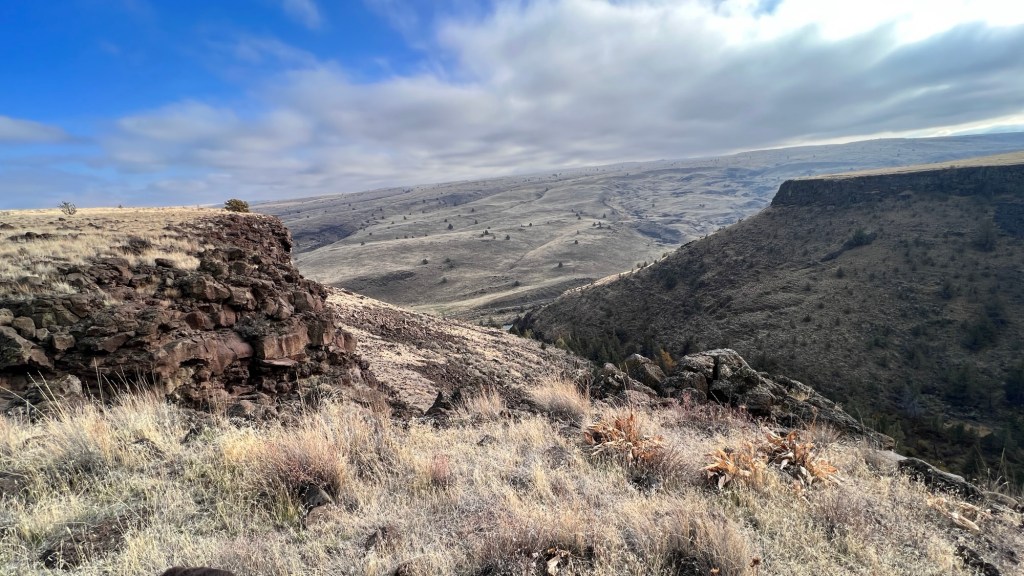
There is a strong draw, felt by a number of nomads, to explore the wild spaces rarely visited by “tourists”. One reason is the lack of transportation capable of handling the washed out, wash board dirt roads found in these areas. Another, the urge to stay in the familiar, attached to cell phones, TV and the comforts of the brick and mortar of a home. When we tell some of our journeys, they all gasp and wonder where we ever got the need to wander.
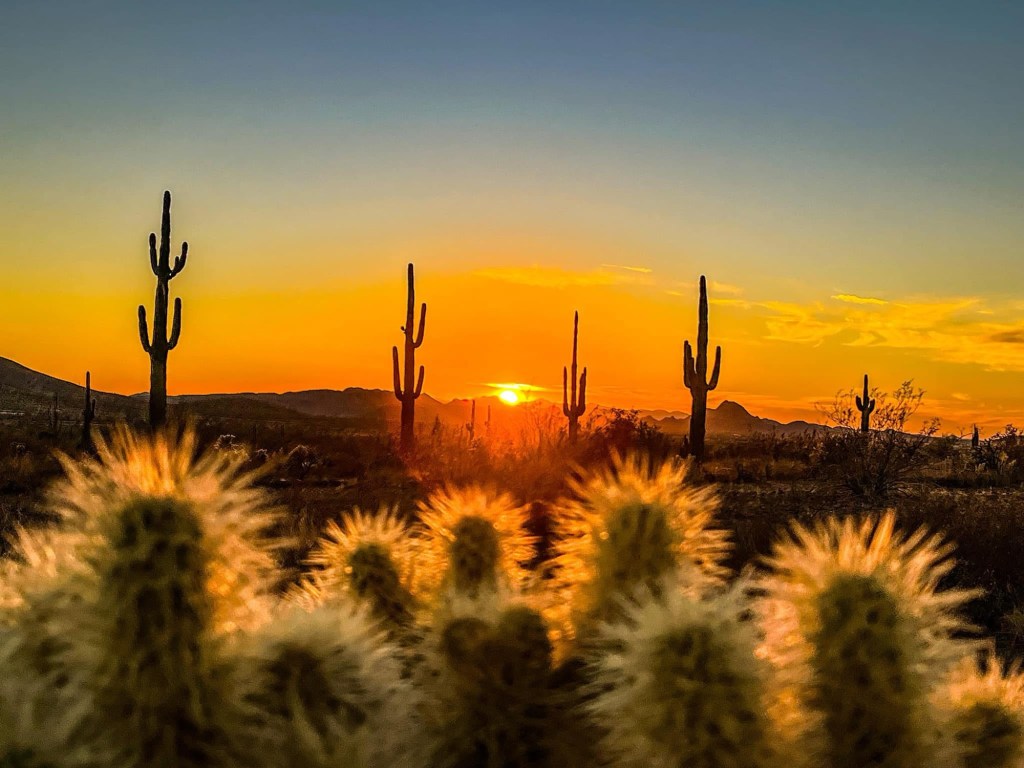
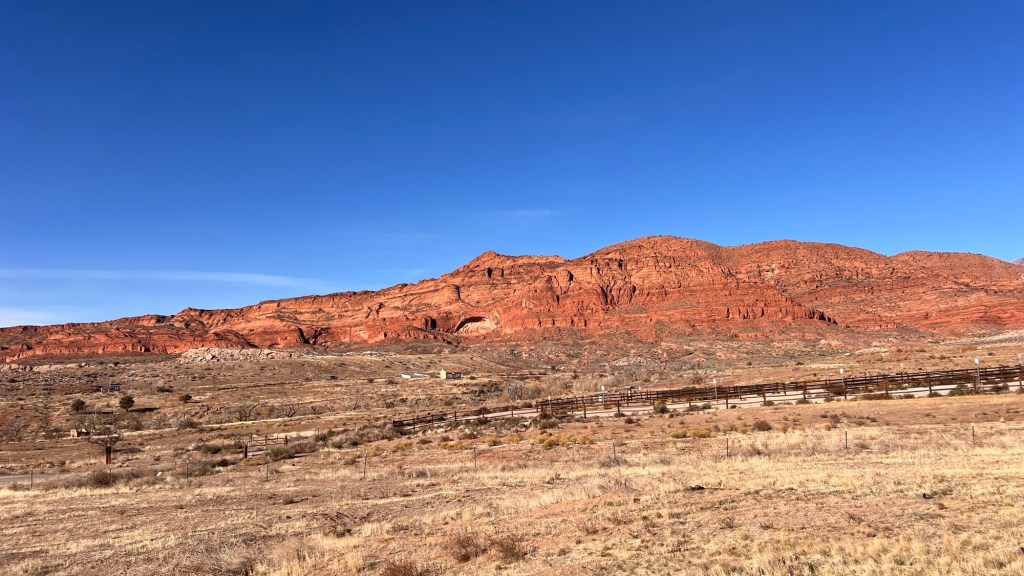
There is a pull to the desert that has enveloped Chris and I. A need for open spaces, a dry climate and room to roam freely, sometimes without seeing another soul for days. The chance meetings often turn into deep conversations and a fire side chat recounting trials and tribulations of life on the road. We share our stories, sometimes harrowing and unbelievable. Perhaps it’s a draw to face death at every turn, or perhaps the thrill of adventure and to push the envelope beyond the comfort level of the normal human. This takes us to today, four and a half years of being free and able to travel at will, one with our surroundings.
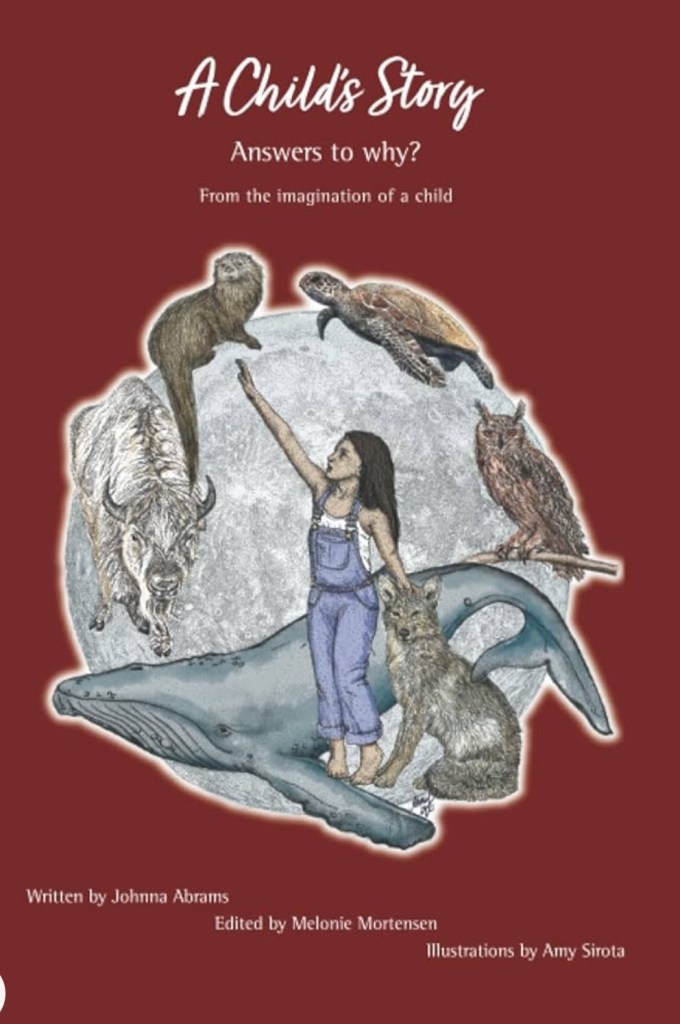
In February of 2021, we hooked up with a caravan of three, Chris and I and two other gals, and crossed the border into Baja Mexico, for the first time. There’s a call we lean towards and freely give into, that paves the way for our wander lust. Baja seemed like the great western frontier that we needed to explore and conquer. Armed with only our cell phones and a good translation app, Garmin GPS, and a competent van, we set out to explore a country unknown to us; a 1,000 mile journey full of new flora and fauna, animals and sea life. I found it so inspiring that I wrote a book while traveling through Baja for 3 months. Fast forward to January 2025 and here we are again.
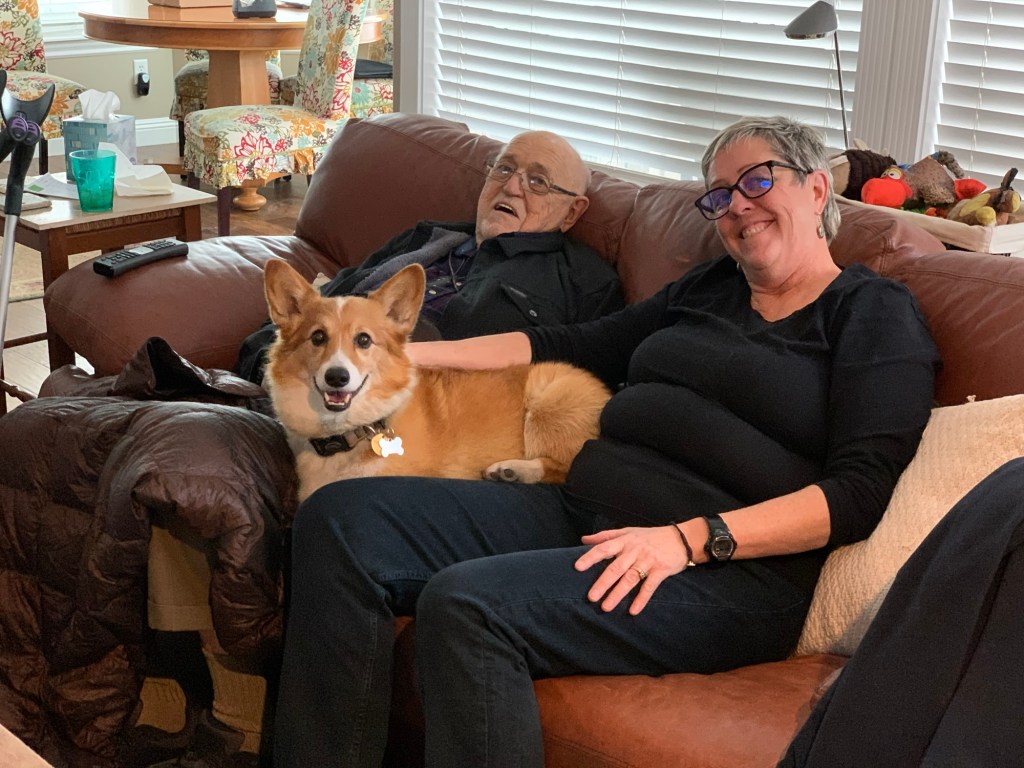
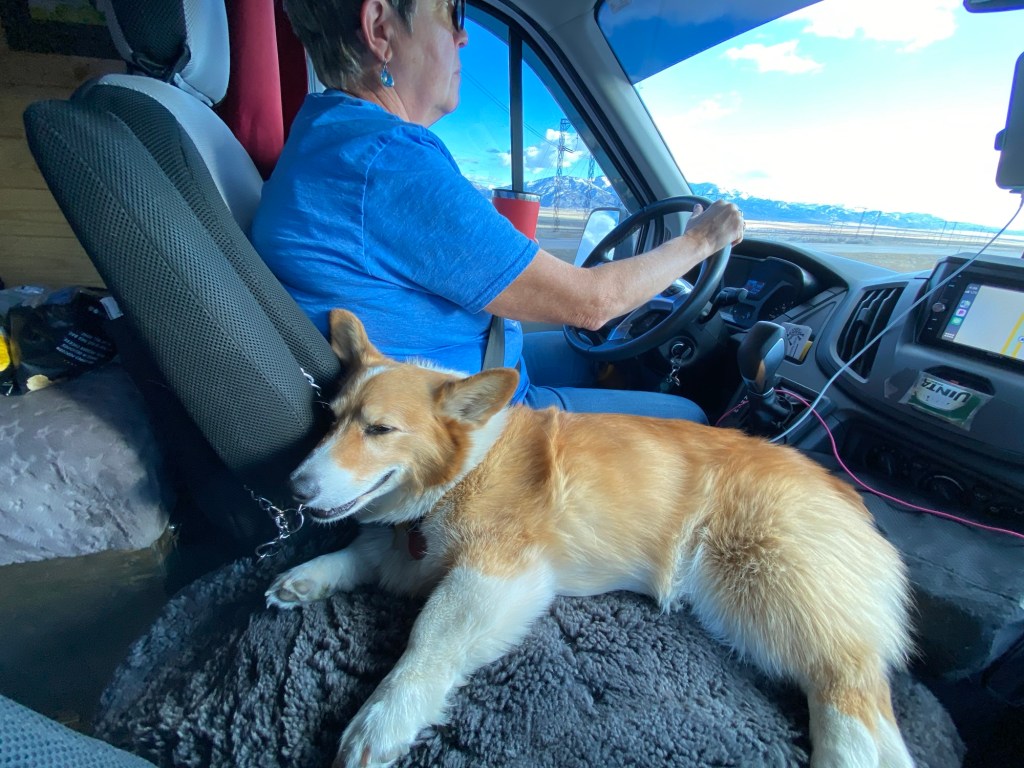
It’s been a tough 2 years emotionally. After loosing our corgi Gandaulf, we sold our first van and all the toys we had accumulated during our travels and set out to travel around the world. Seven months traveling around Europe and another four months in SE Asia, Indonesia, and Malaysia, then back to the States where we purchased another van to complete the Canada/Alaska trip we missed out on during our two and a half years living on the road.
Alaska and western Canada is another frontier of sorts. Not like the desert but just as grand and open. The roads in each very similar; pot holed and delaminated. The punishing washboard roads in dire need of repair, are enough to put any van build or truck to the test. there would be whole days of traveling 3-400 miles and never cross another vehicle. We were never sure if the paved sections of the roads were better than the dirt roads, both held their own dangers. The grandeur of the Alaskan and Yukon outbacks are hard to match, even in the deserts of the south western USA. Still, the desire to revisit Baja California, Mexico and the desert was strong.
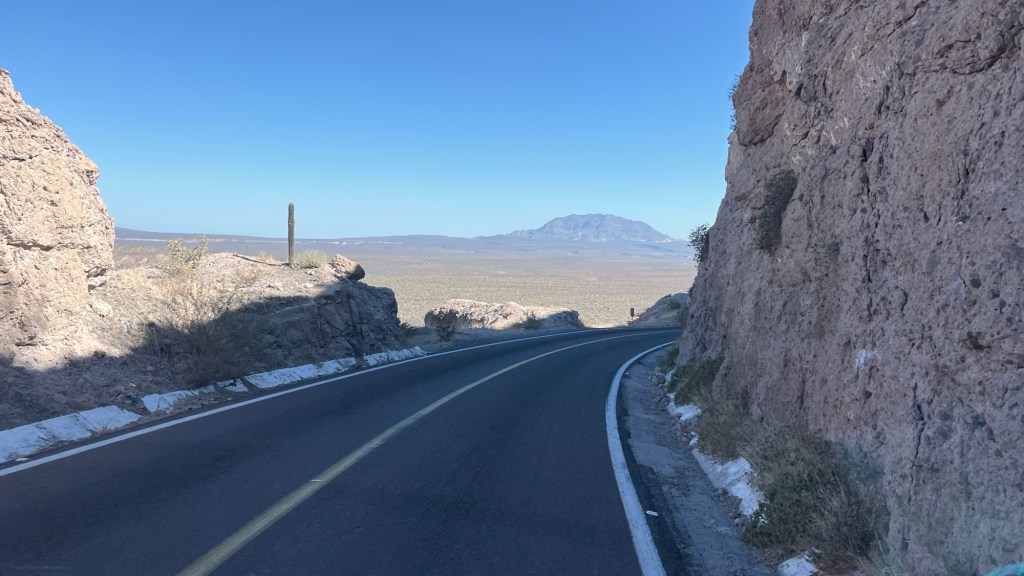
Today, January 6, 2025, I’m writing you while enjoying coffee and the warm sun of La Paz, Baja California Sur, surrounded by fellow travelers. We’ve traveled 1350km so far, with another 300km to go. The roads to this point have been narrow two lane highways, with little to no safety lane and often no shoulders. There are times when we must come to a complete stop to walk the van through deep potholes and slow to a crawl when passing trucks come barreling around blind corners. There are constant signs of accidents, both with roadside crosses and mangled guardrails, straightened out or completely ripped from the supports and trailing off into deep ravens as if pointing to the site of a wayward vehicle leaving the road and plummeting to its end. Often times, there will be stretches of road that have carcasses of dead cows, horses or the unidentifiable remains of some unfortunate animal, usually struck at night by a speedy semi, as they come to the flat roads to sleep. It’s a constant reminder that it only takes a second of misfortune to end a life.
So our nomadic wandering continues with so much more to see and experience. We may be absent but we are always present where ever we find ourselves. Living in the moment, sometimes with no set direction but forward. Always savoring the newness of each destination and rolling with whatever may come our way.
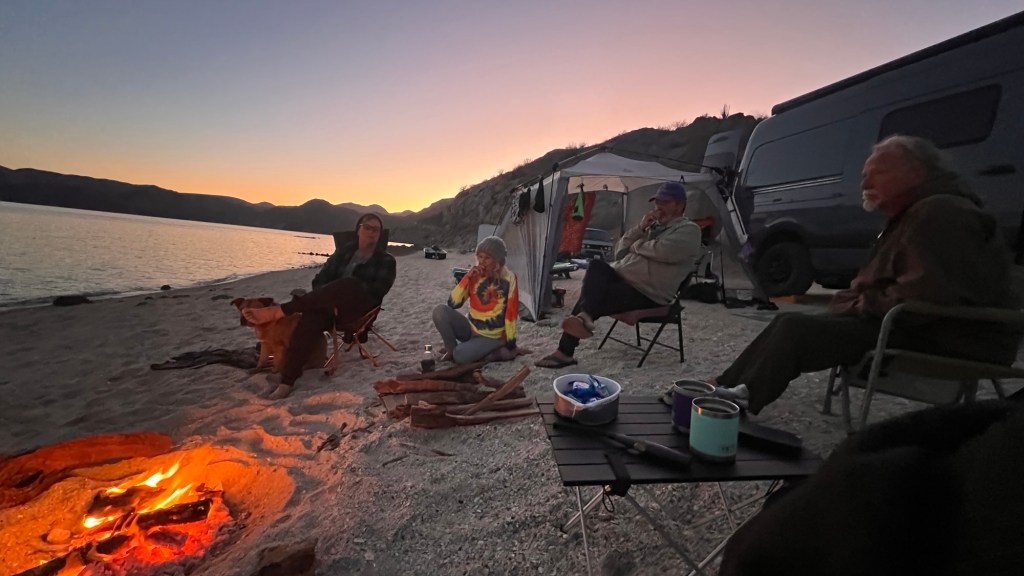
I’ve been sitting on this lovely mesquite wood since I pulled in a day before Chris could join me. I caught an awful cold which continued to infect my lungs and finally today, I feel human again. It’s been a long month. I brought out my axe and picked the wood I thought I could split and had at it. I managed to take 7 of the 10 pieces of gnarled mesquite wood and cut it down for smaller wood and kindling. Invited new friends, and had a night of hearing the new version of campfire stories.
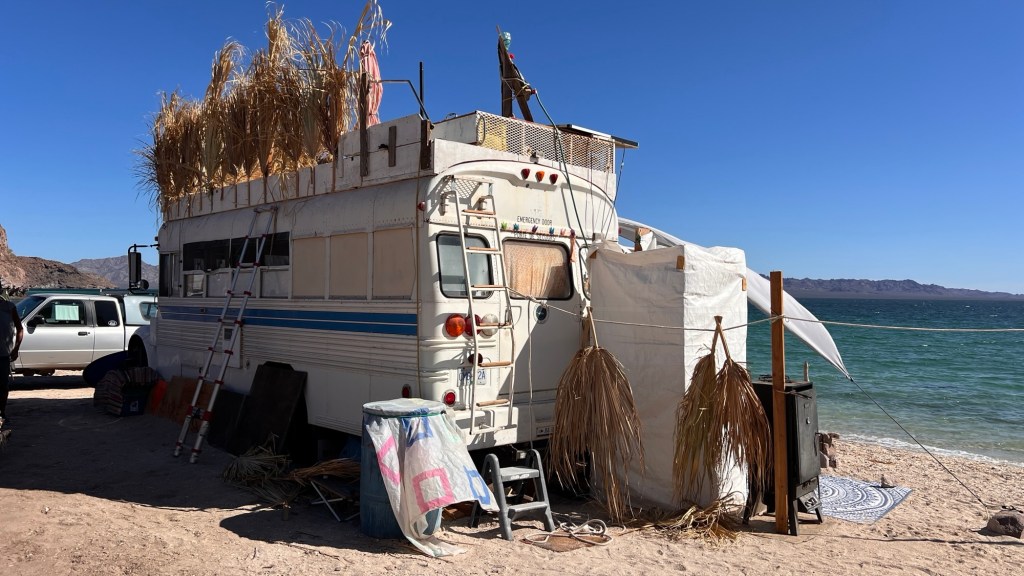
We all are from different places and times, some old some a little younger. Some have physical property, land with or without a dwelling, and some have what we’ve arrived at this beach in. No matter, we are all a family unlike that you find. A community of like minded individuals, that, for whatever reason, have the need to wander.
For some it’s a place that is not too pleasant in winter months, some who drive south into Baja as an escape from the gloom and cold winters. For Others, just an escape from some demons chasing them, known or not. For us it’s a chance to take a camping vacation on the beach, where we can stop and unload and finally sit still for more than a day.
Baja Sur is like the old western movies you see. Gauchos riding amongst the cactus and mesquite, Palo Verde and Palo Blanco trees dotting gnarled rocky desert landscape. Tall pilars of crumbling hills and buttes stacked on the ground like the fins in a dragons back. Hot arid air burns the skin and in the city is often full of Mexican polkas and meriotche.
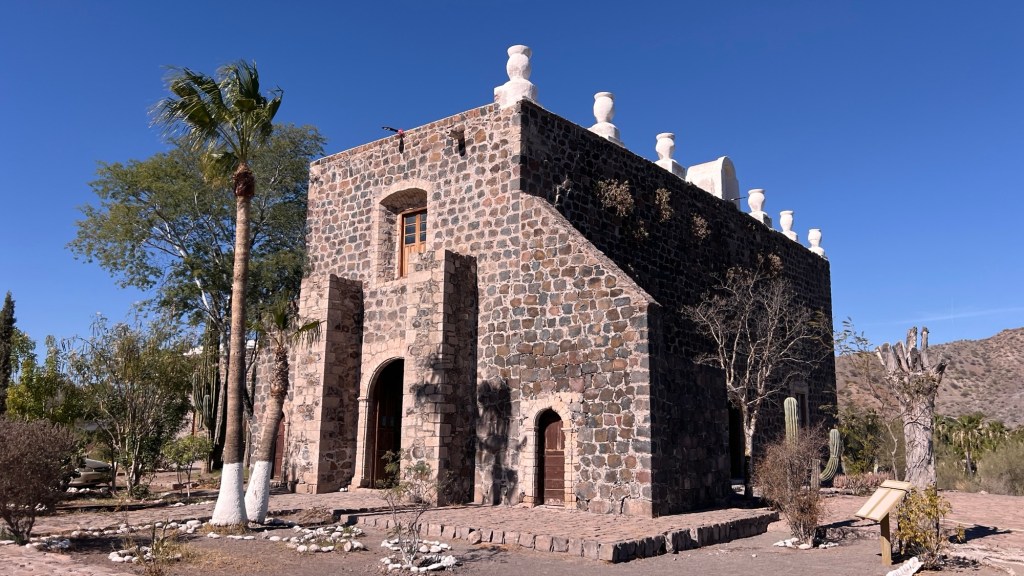
We’ve moved to Loreto, about 2 hours further down the coast, to visit our long time friends who live here now. They live in the Historic Centro of Loreto, a maze of streets that eventually lead to the main Malecon. Bahia Loreto fronts the Malecon and is often a churning white capped sea. There are many gringos mingled with the local Mexicans living in the historic district. Loreto is more like an oasis than the desert. The Centro is centered around one of the 3 missions in this area. A mix of shops and cafes line the Centro. Coffee shops and artists round out the collection. Arched trees provide shade and beauty.
Time to stop and live outside the van for a week or so.
Well, we’ve made it down into Baja California Sur, Mexico. The journey down took the best part of a week. There are numerous military check points along the way, mostly just curious federales except coming into San Ignacio, those guys are jerks.
The driving was a bit hairy after we connected with the main highway Route 1. The road is plenty wide enough for our van and a semi…as long as everyone stays in their own lanes. The last trip up and over the mountains and into Santa Rosalía was the last of the dangerous stretches of windy mountain passes for a while. We were told there’s an accident almost everyday.
Our push to get to Mulege and Bahia Concepcion paid off in spades until Chris came down with the same cold I was battling and we opted to get a hotel room in Posada Concepcion to get some rest and take some long hot showers to try and get on top of our sickness. After a day I pushed on to the beach to set up camp, Chris stayed behind for one more day.
View from the hotel room
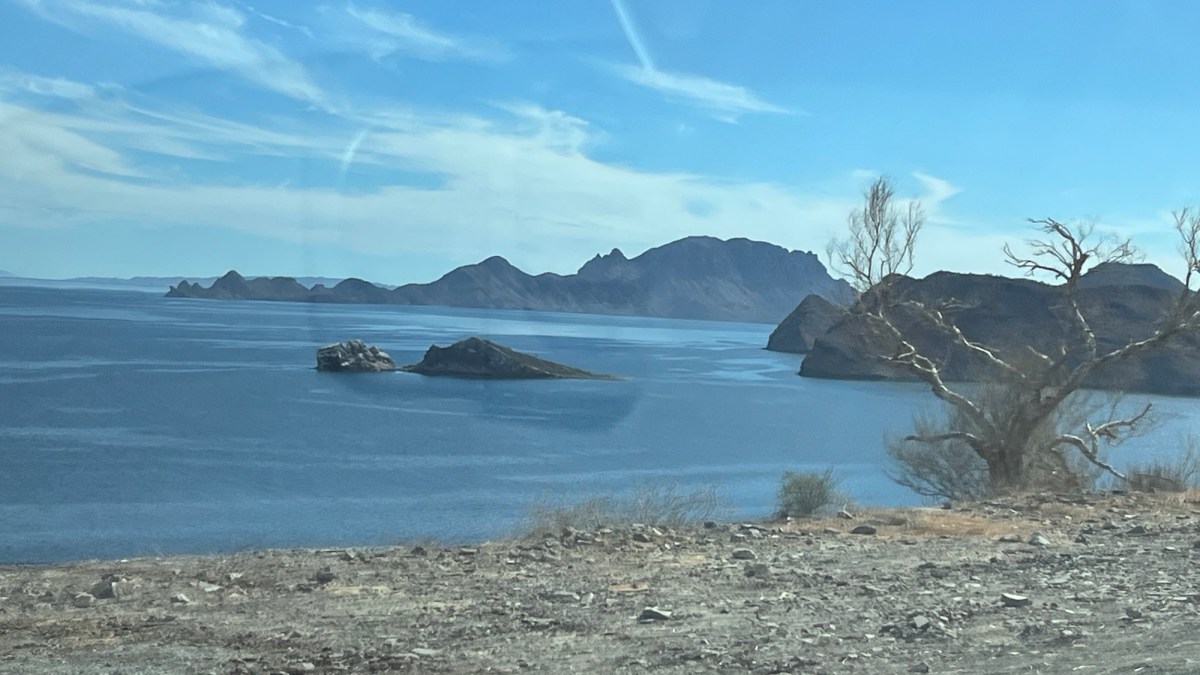
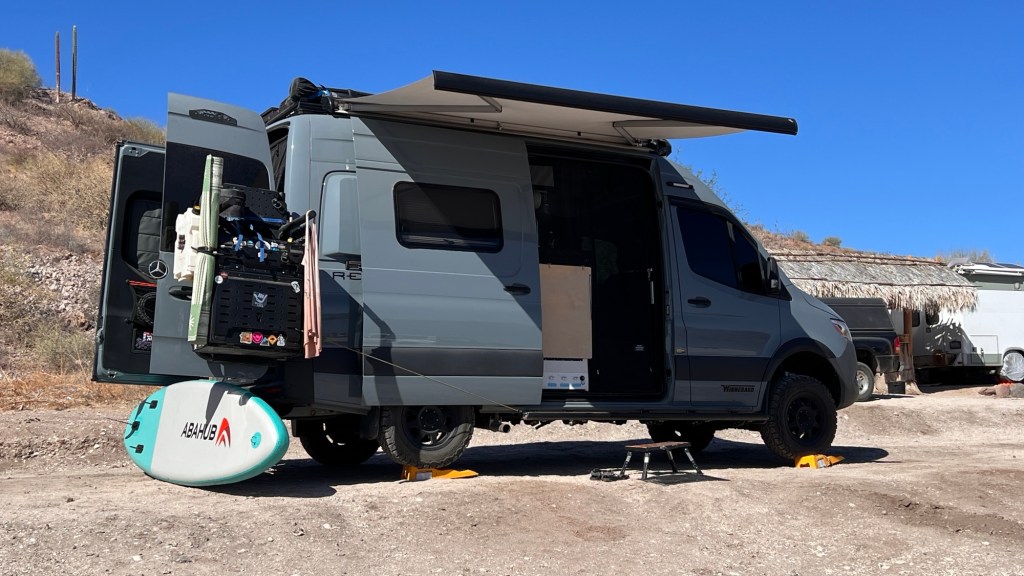
A nice camp spot was saved for me by Frank and Linda, right on the beach only 20’ from the high tide line. The beach is made up of broken shells that have been pulverized into course sand. There are starfish, pelicans, seagulls and turns, dolphins playing in the bay and dozens of paddle boards and kayaks skimming the water as far as one can see. The gentle lapping of the water along the beach lulls me into a trancelike state until the seagulls cry snaps me back.
Our camp
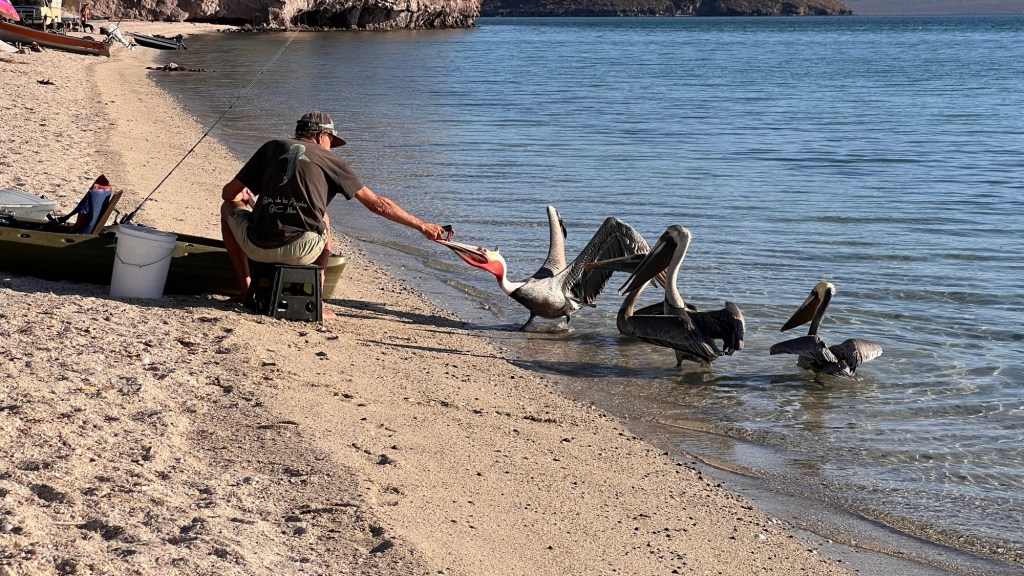
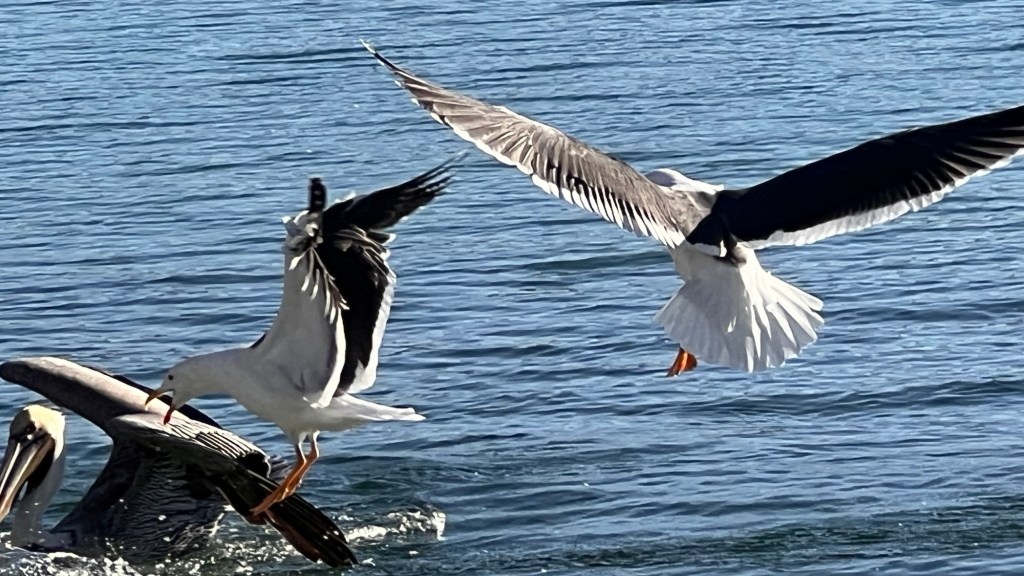
Every morning, several beach dwellers take out kayaks and fish. Upon returning, they clean and fillet the fish they caught. This daily ritual has attracted 5 large brown pelicans and 2 seagulls. The fisherman feeds the pelicans and the seagulls scream at them, sometimes pestering them enough they get a small morsel. Lazy birds.
Everyday a gentle breeze picks up in the early afternoon, turning the glassy waters of the bay, into small wave trains that lap at the shore and make for some fun paddle boarding. There’s little trails leading up into the hills that surround the beach, a larger area with a dozen or more palapas, outhouses with smelly pit toilets, we use our own and take the cassette once every 3 days and dump it in one.
Colorful Bay of Concepcion Bay of Glassy waterSun sparkles
On any sunny day, the bay turns aqua green with deep blues and turquoise. Dancing in the water are sun sparkles, glitter from the sun. If you squint your eyes those sparkles become sun drops splashing into the bay. I squint and watch these little jewels of light as they dance on the top of the water. Another day another sand dollar.
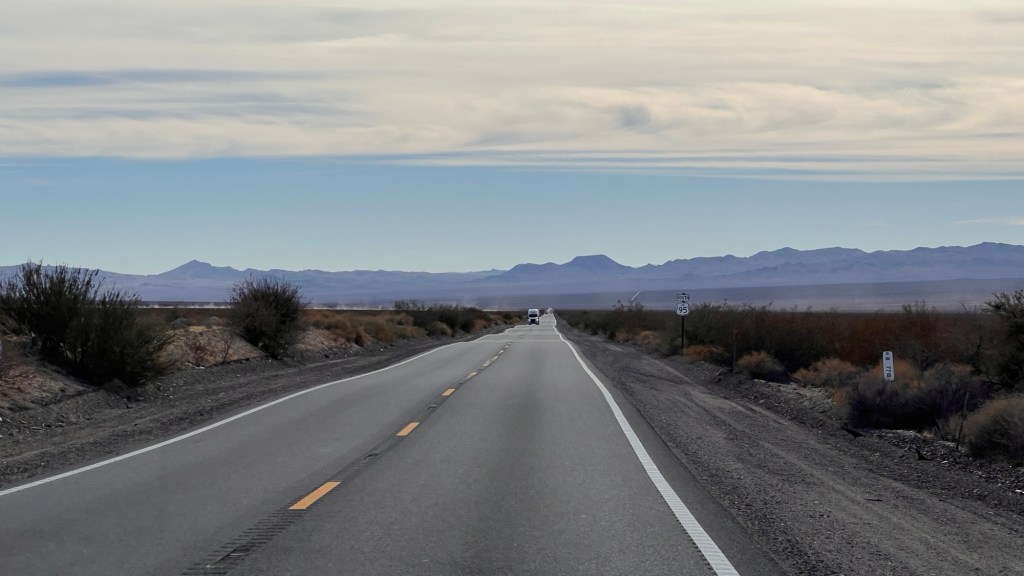
To say our lives are boring, would be the biggest lie anyone ever told. Today we find ourselves on a pilgrimage down to Baja California. Driving through the barron desert of California’s Mohave. The vast emptiness is overwhelming and all encompassing. Creosote, desert rose, sage, Joshua trees, and various other spiny shrubs, dot the desert floor. Whips of dust circle and rise into the sky in thin tornadic spouts. The desert has a beauty all its own.
As we make our way, small desert communities spring up in the middle of nowhere. Towns like Needles, Searchlight, and Topok breakup the monotony of flatness. We wonder what the inhabitants do for fun? Chase jackrabbits…wander around in altered states of mind. Sit on porches rocking in old wooden rocking chairs. Commune with the vast sky? There’s a certain peace found here in the desert emptiness, vastness that is beyond measure. A kinship with Mother Earth, a pleading of the poor souls living among her scorched soil and dwarfed trees and plants.
For the next few months we will enter this environment willingly, searching…searching for that kinship, immersed in the life of leisure. Healed by the salt air. Lost in days unknown, time lost, only day and night. Wander around with like souls just living life on the peninsula’s terms. It’s time to disassociate from the tension and unknowns of life in the US.
We are looking for somewhere to call home base. Someplace we can travel out from or just hunker down and become part of a community. Who really knows. What I do know is, we have wandering spirits that are hard to quench, hard to convince to stay in one place…wanderlust.
It’s warm and cozy, sitting in Willow (our van) with the heat on. It rained last night, as usual, and the morning sun is busting out at the seams as the heavy clouds give in to the coming day.
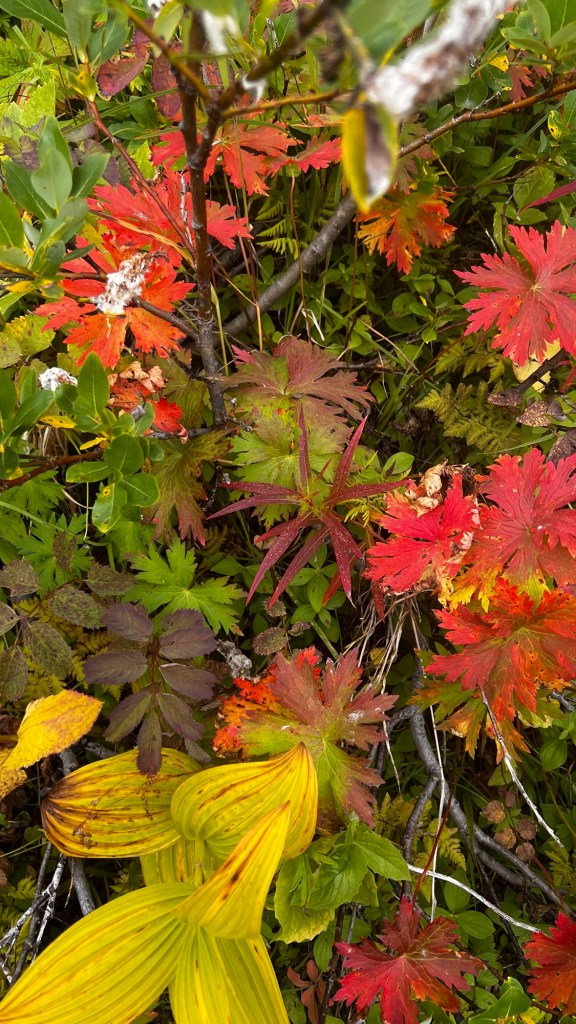
The rain drops sit poised on the edge of the turning leaves and bushes on the forest floor, just waiting to bedazzle the world when the sun finds its small existence. The lack of squirrels portends the coming of the fall chill and the stupendous color change beginning. For the last month, these busy little creatures have been scurrying from tree to tree, digging holes and filling them with a winter bounty, if they can find them under a blanket of fresh snow. The geese have been filling the skies in huge, jagged Vs, honking as they begin their southerly migration. Perhaps we should take note of these happenings and head south ourselves.
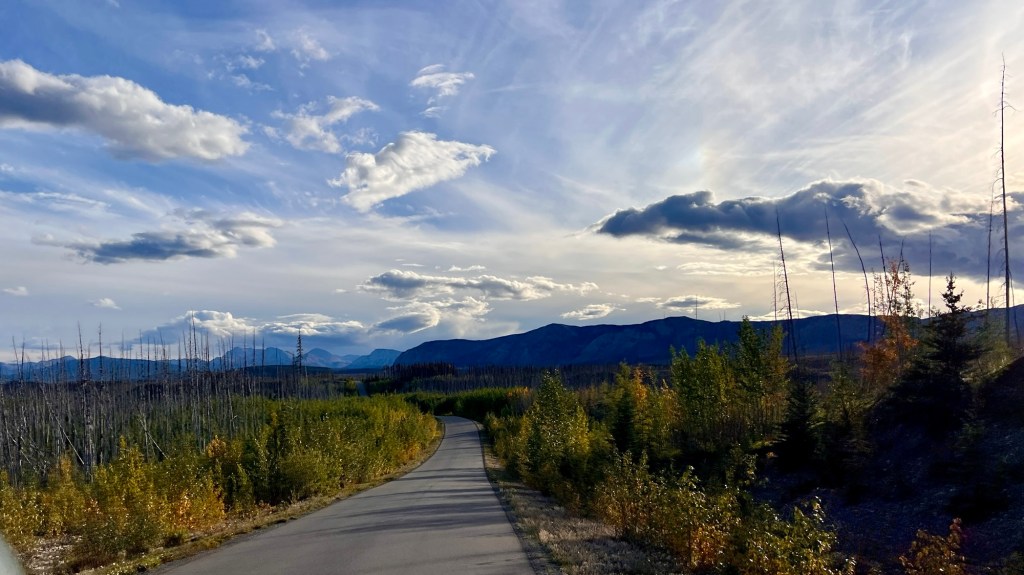
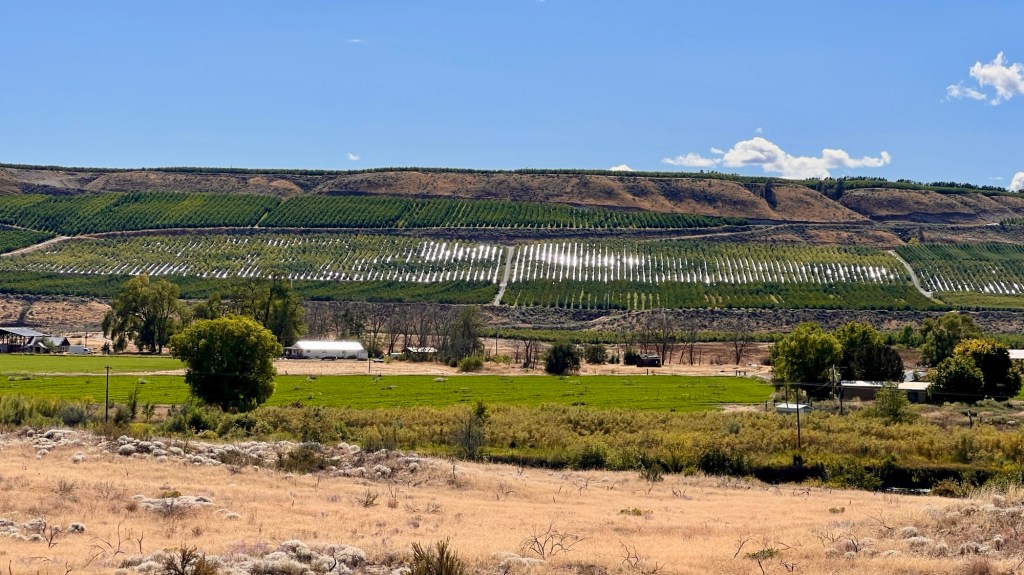
We crossed the border from British Columbia Canada, a few days ago. The fall colors slowly fading out and the green leaves have reappeared as if we passed backward through time. The spectacular mountain vistas giving way to the subtle rolling hills covered in orchards and vineyards, then the unending flat fields of golden grains, farm houses and rogue silos, interrupting the golds with a few ancient cottonwoods, tin roofs glinting the suns rays like a diamond amongst the fields of gold. We’ve been sticking to wandering the backroads, trying to eek out whatever new experience we can find as we meander southward.
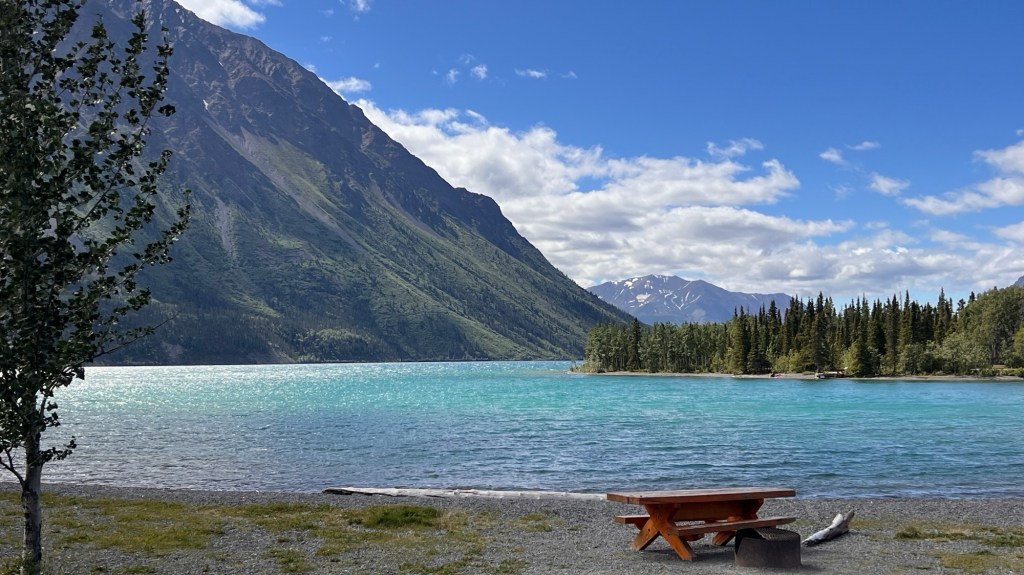
It’s always bittersweet when we move from one place to another. This trip, now spanning over 9,500 miles, has seemed like a blur. The vast Canadian wilderness, coupled with the wildness of the Alaskan frontier, has made it easy to immerse oneself in nature, primal and raw. To have an intimate insight into the lives of the First Nations people, the animals and fishes that roam the vastness, the small plants, boreal forests, 14,000’ mountains, glaciers and lakes, Arctic tundra, towering fiords, and so much untamed beauty…has been a blessing that is etched into my mind forever.
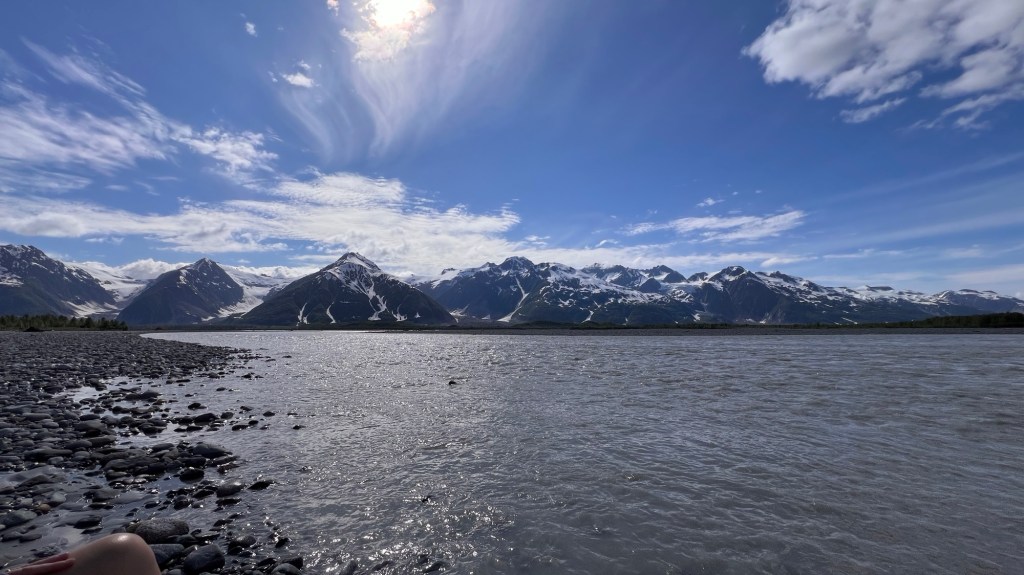
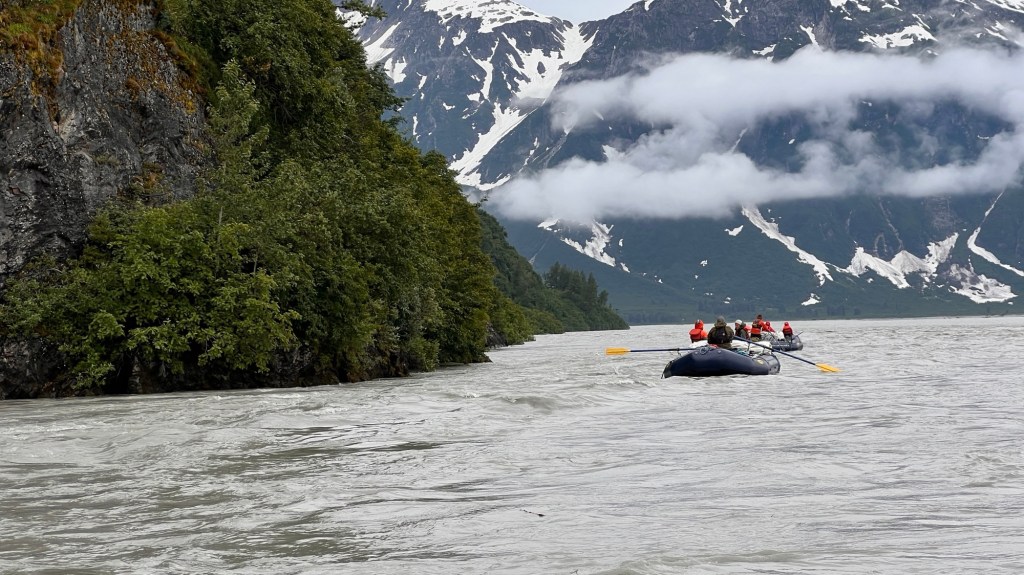
We’ve just returned from an amazing Canada/Alaska River trip down the Tatshashini and Alsek Rivers, down into Alsek Lake and take out at Dry Bay. The whole trip took 13 days plus travel time of another 13 days to Haines, Alaska.
Although the river trip was not on our bucket list, traveling around western Canada and Alaska was. The river trip became the catalyst for this new chapter in our adventure.
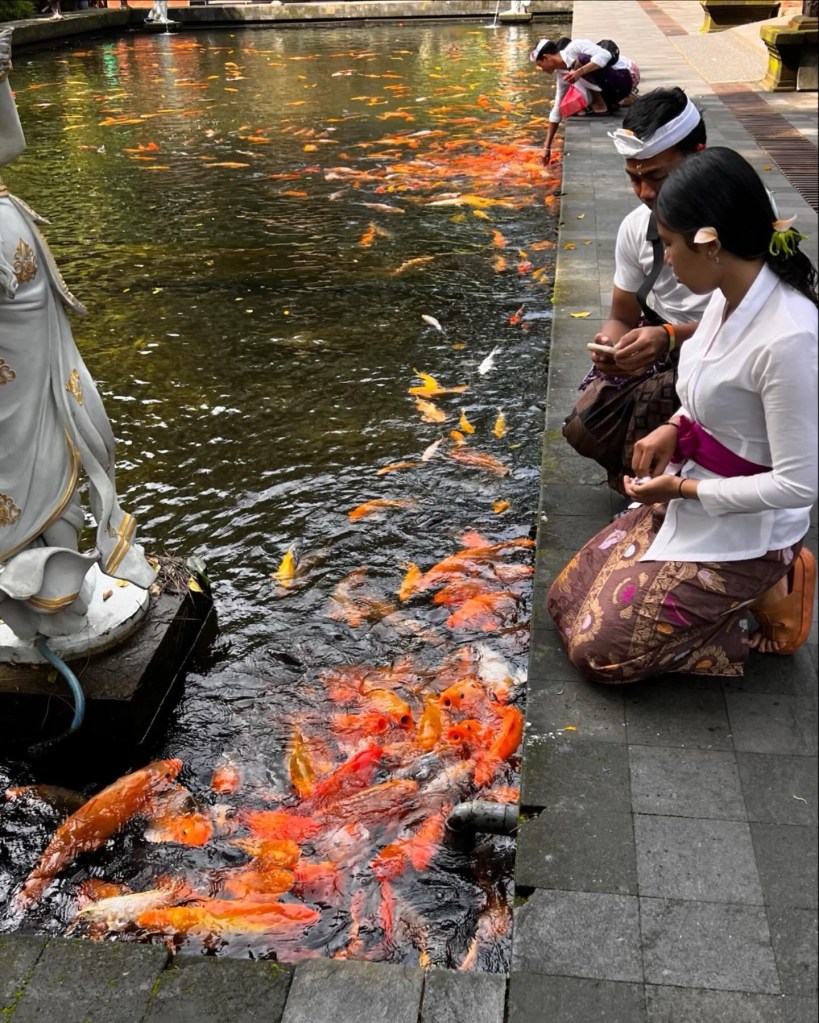
As we sat in Bali, melting from the oppressive humidity, we realized our travel in the blazing sun, and blazing kindness of its people, needed to come to an end. We had covered much of SE Asia in a 4 month period: countries like Singapore, Thailand, Vietnam, Laos, Cambodia, Korea, Indonesia, and Malaysia. It was an other-worldly experience, and touched both of us deeply…but our bodies were screaming for a break from the heat.
We found ourselves thinking of very cold places, Antarctica, Iceland, Alaska, Patagonia. Big dreams of cooler temps, zero humidity, even some of our old haunts just didn’t excite us. When Chris saw the Facebook post from Bio-Bio River Expeditions, for a trip down the beautiful Tatshashini/Alsek Rivers. Pictures of rafts floating around stunning blue icebergs grabbed both of us by our sweaty hands and led us down the rabbit hole. This was it!
So we set off on planning to see if we could make this happen. We picked up a Sprinter Revel Van, outfitted it for the arduous trip, bought the necessary clothing and secured a seat for us on the trip.
The drama began with seeing the expensive nature of this undertaking. We bought the van because renting a van or RV was exorbitant. Then came my tummy health issue, then the breakdown of the van as we set out. We made it to Skagway, caught the ferry to Haines and settled in a few days before the trip and one more hiccup, Chris broke her tooth and needed an emergency appointment with the only dentist in town. All that was now water under the bridge, no pun intended, as we suited up in supplied dry suits and met our group.
The next morning was glorious, sun shinning, smiles all around. An amazing feeling of joy and a bit of trepidation hit me as we stood on the river bank, red dry tops, blue dry pants and insulated black and brown mud boots, red life jackets cinched up tight. Within an hour or so, we came to our first splashy wave trains, one finding its way into my dry suit, chilling me and reminding me to hold on.
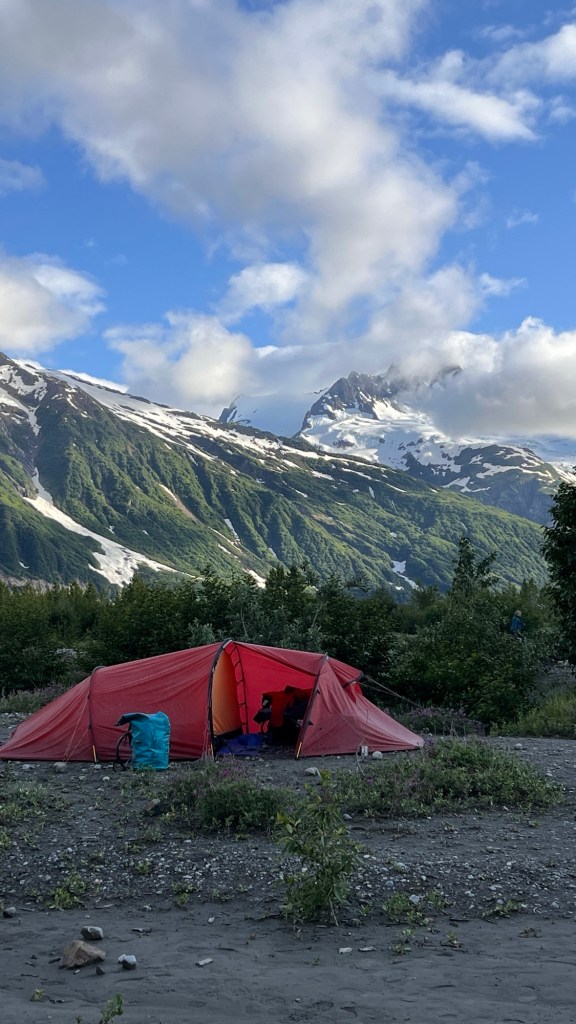
Camp was always beautiful and we scrabbled to find a level, clear area for our tents. After a few days, the tents became a pain in the ass! They were short and squatty, making entering and exiting very difficult without crawling on hands and knees across wet, rocky ground. The sleeping bags were warm and cozy…bonus!
There is just so much running through my mind when I think of the days on the river itself. Once in a while we were asked to paddle, sometimes to help propel the rafts, other times just to stave off the cold chills of the cold rain and biting winds blowing downstream. We all looked like a blue rubber basket of Easter eggs, as we curled up in tight balls to conserve heat. Some days presented with sun and a promise of grand vistas and windless travel. These days would take your breath away as around each river bend, new wonders appeared. It was somewhat difficult to figure out how to layer under the dry suits, but no matter when we left shore, dressed like small children going out to make snowmen, we soon were adding or removing layers…from hot to cold and back to hot if you were lucky, but little in between.
Camp life was usually pleasant, except when the mosquitoes would swarm. The weekend before we arrived at Purple Haze camp, there had been 6” of rain in a 24 hour period, probably why we had wind and rain further upstream. This rain awakened the veracious insects. Black flies and mosquitos topped the ticket. These tiny, or not so tiny in the case of some mosquitoes, will drive you mad! We were lucky that only a few camps seemed to be utterly infested with the biting menaces, and happy they were only one night stays. Everyone adorned head-nets and deet was the preferred perfume of the evenings meal. Dessert was passed on as we all ran for the shelter of our squatty little tents and played the game of smash the rouge mosquito that found its way into the tent, it only takes one of these little bastards to drive you batty.
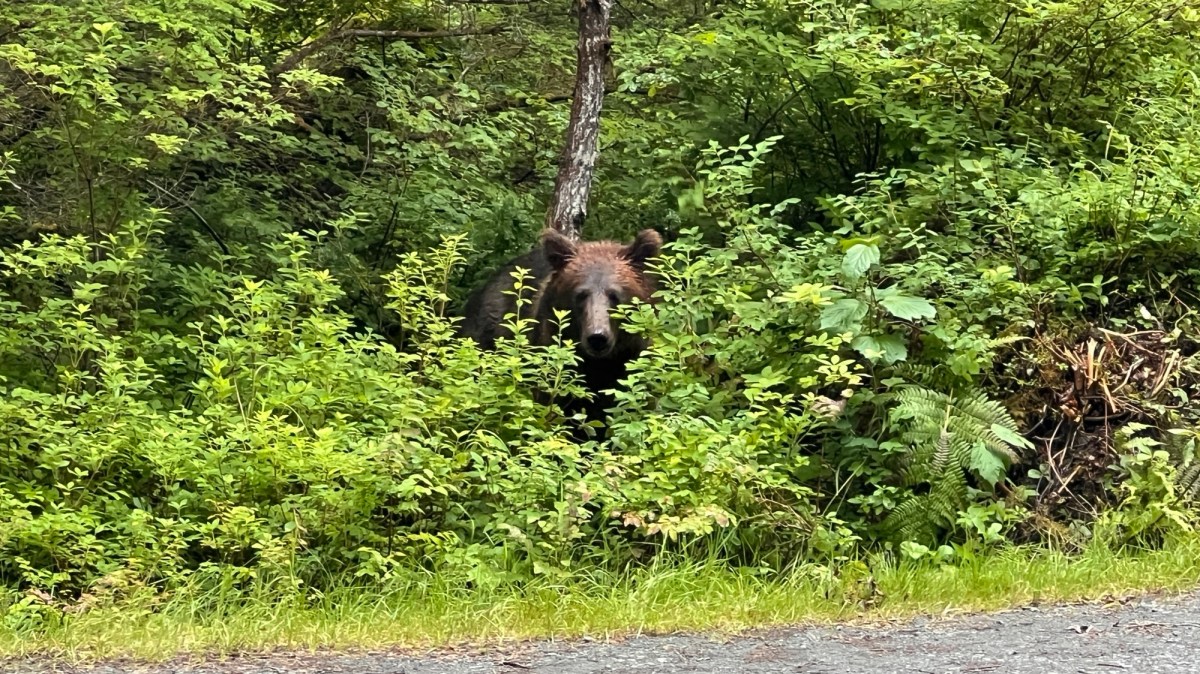
Alaska has its beauty and also is a harsh environment. It is not for the faint of heart. True Alaskan wilderness is not forgiving and should be entered with caution and care. On the last day, we found out that our pilot had gone missing with 2 others the day before. Due to the search, no plane was coming to get us. These were seasoned veterans of this Alaska wilderness and its small communities that depended on their services. Tragedy and grief is not an emotion I thought I’d experience on this trip.
I can’t tell you if I was ready for the myriad of emotions I went through but in the end…it was an experience of a lifetime and one that will be remembered. Alaska is wild, natural, stunningly beautiful, incredibly demanding and deadly.




































 Two Travelin' Chicas...